(the story of the Venus Flytrap and the Green Swamp)

Each Spring, while others look ahead to upcoming plant sales, I think about the Green Swamp. Southeastern North Carolina’s Green Swamp is the home of a variety of carnivorous plants and the native range of the Venus Flytrap. The presence of Pines, specifically Longleaf Pines, shape and anchor these inland nearby coastal areas of southeastern North Carolina. The answer for how and why these areas came to be is found in the soil: acidic, peat based, nutrient poor, with a high water table. Further, the land, ecosystem, and history of its inhabitants is fire dependent. These elements combine to provide framework for a unique indigenous plant community of familiar faces, strangers, and oddities such as several species of distinct Pitcher Plants, some psychedelic sundews, aptly named Butterworts, unusually named Bladderworts, otherworldly orchids, and the Venus Flytrap.

The Green Swamp is incredibly diverse in flora, fauna, and history. In 1983, University of North Carolina (UNC) academics Joan Walker and Dr. Bob Peet, wrote a treatise on the “composition and species diversity of pine-wiregrass savannas of the Green Swamp, North Carolina.” To summarize, the fire-maintained plant habitat of the Green Swamp is amongst the most diverse in the United States. However, getting there isn’t easy.
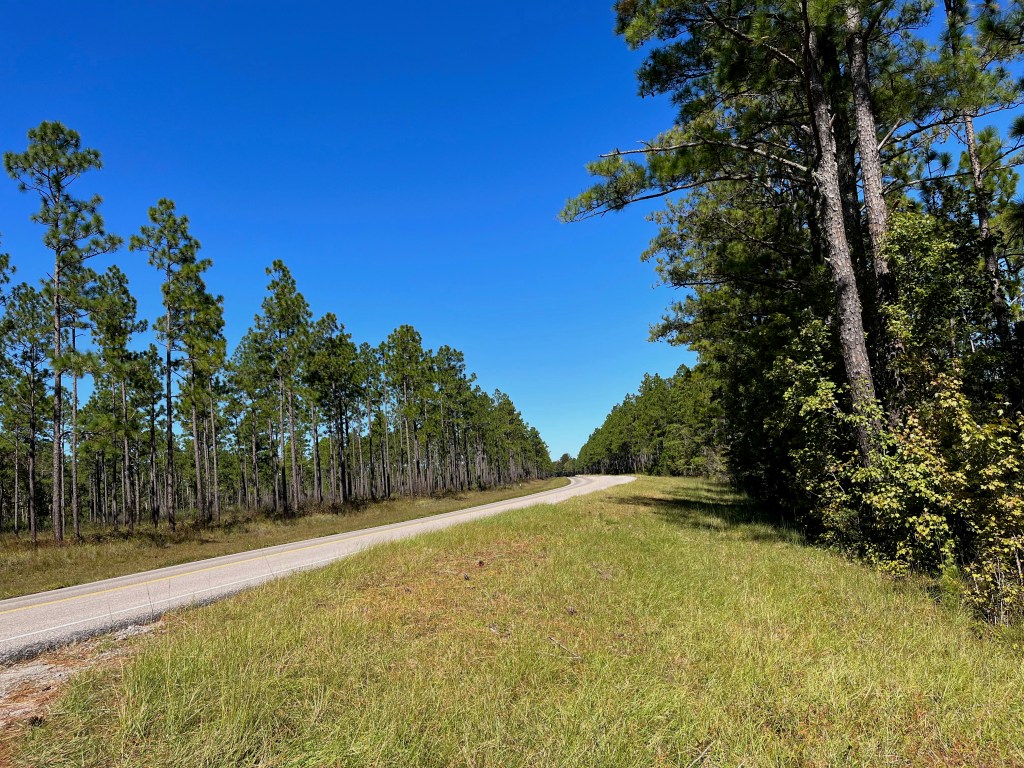
While it appears closer on the map, the Green Swamp is not really close to anything. The coastal city of Wilmington is a far 41 minutes (36 miles) to the east and Myrtle Beach, South Carolina is almost closer. Exiting from I-95 east towards U.S. Route 74 drops you off on the long straightaway of flatwoods monotony. The roadside scenes repeat and cars drive in unison at the same speed. In situations like this, there is a tendency to be lulled into hypnosis. There is a magnetic pull clutching at your carwheels insisting you stay on the road and not exit. Fighting through this cosmic puppeteering, as you exit at Bolton, towards the town of Supply, time slows and ideas of distance are extended. It takes effort and perseverance to get there, driving through the rural pineland folk swamp world of North Carolina. There are no stores, no gift shops, and barely a sign announcing the Green Swamp Nature Preserve.

Perhaps because of grandiose National Park expectations, there is a specific anti-climax upon arriving at the nondescript dirt road parking area. There is a bulletin board structure with some general paperwork posted and a faded-out map of the Green Swamp. In my experience, there has never been more than a car or two in the parking area. On your immediate left, there is a sizable body of water shielded by a shrubby understory. Continuing on, the Green Swamp reveals itself slowly, transitioning in phases, often due to slight elevation and hydrology changes. The further you walk, the more difficult it gets to turn around.
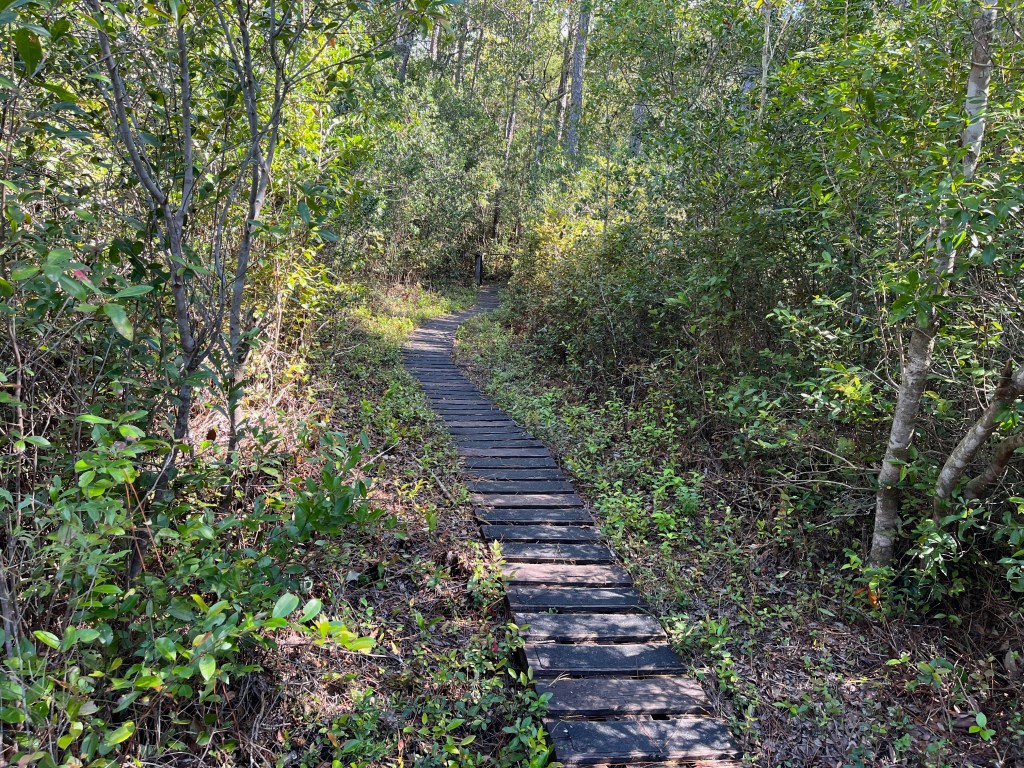
Once you cross the barebones rustic boardwalk and through a ragtag section of overgrown shrubs (pocosin), the land opens up. On a good day, a steady breeze rolls through the canopy of pines. Visually, a color wheel of contrasts lie ahead with the bright color of carnivorous plants highlighted against a background of drably warm browns and greens. Even the living sphagnum moss covering the ground is vibrantly colorful. Despite being a swamp, the preserve is relatively easy to traverse – especially while staying close to the pine needle path. The skyward canopy of Longleaf Pine (Pinus palustris) watches over the land with stillness and resolve.
Longleaf Pine infamously spend ten years as immature saplings, mimicking inconsequential grass clumps, before bolting upwards as trees. Upon closer inspection, the spiky three needle per bundle clumps are giveaways to their identity as pines and not grasses. In time, these trees become long, slender guardians of the forest and able to reach heights of 120’ with long 18’ needles atop their scaly orange brown prehistoric bark trunks. Patchwork clumps of Wiregrass (Aristida stricta) bind the plant composition together. Notably, Wiregrass mopheads cannot flower without fire.
Wherever there are noteworthy plants in the southeast, there is usually gunfire in the distance (often but not always from military training bases). Yet, at the Green Swamp, there is a peaceful, church-like zen atmosphere with intermittent sounds of Eastern Bluebirds and their cheerful low pitched warble, Red Cockaded Woodpeckers rhythmic peck, miscellaneous other sing song bird chirping, multitudes of insects buzzing, and the percussive sound of shoe sole stomps against spongy sphagnum moss. Note: I have never seen an American Alligator at the Green Swamp but I have seen them at the nearby Lake Waccamaw, often roadside, by water in small groups smiling in sun.

As mentioned, this Pine plant community is fire adapted. The pristine look of the Green Swamp land is due to periodic prescribed burnings, which clean up the landscape by removing overgrowth shrubs and trees which would in time shade out other herbaceous plants. Annual prescribed burns and land management, in theory, limit larger wildfires. But, incidents do occur. Evidence of the effectiveness of burning can be seen by driving to outside areas under different land management. These unburned areas are overgrown with a succession of trees, shrubs, and vines (often exotic) and an overall absence of light which limits the longterm growth of the understory plant material.

Longleaf Pines are long lived and sturdy. Many were historically logged and replaced with the faster-to-grow Loblolly Pine (Pinus taeda). Notably, Loblolly and Slash Pine are not fire adapted. Longleafs have a history of being moneymakers too. Entire industries of turpentine with workers harvesting pitch from around the heartwood, migrant workers raking up pine needles to be farmed out to the local landscapers for mulch and, during the Revolutionary War, the British Army pillaged these trees for their upright, straight trunks soon to be ship masts. Interestingly, the hulls of the same ships were said to be sculpted out of the other famous coastal Carolina tree, the Live Oak (Quercus virginiana). Presently, the distribution of Longleaf Pines is only 3% of their previous range.
In 1974, the 15,907 acre Green Swamp was designated a National Natural Landmark though I am not entirely sure what that level of protection means. The boundaries of the preserve are loose and nearby residents live within or close enough to the preserve to serve as caretakers. Others ignore their proximity to the Green Swamp. Around these parts, watch out for official or unofficial hunting seasons. In the Carolinas, there is a complex series of dates, weapons and acceptable prey to be hunted almost year round. For example, Bobcat season is Oct. 18 – Feb. 28, Muzzleloader or Blackpowder only. Deer season is Oct. 2 – Nov. 19. Peak swamp bloom time is early May and into June so you should be ok. When in doubt, wear bright colors. People tend to stick to the paths in the Green Swamp. Where there is no path, muddy tire tracks from trucks make their own paths.
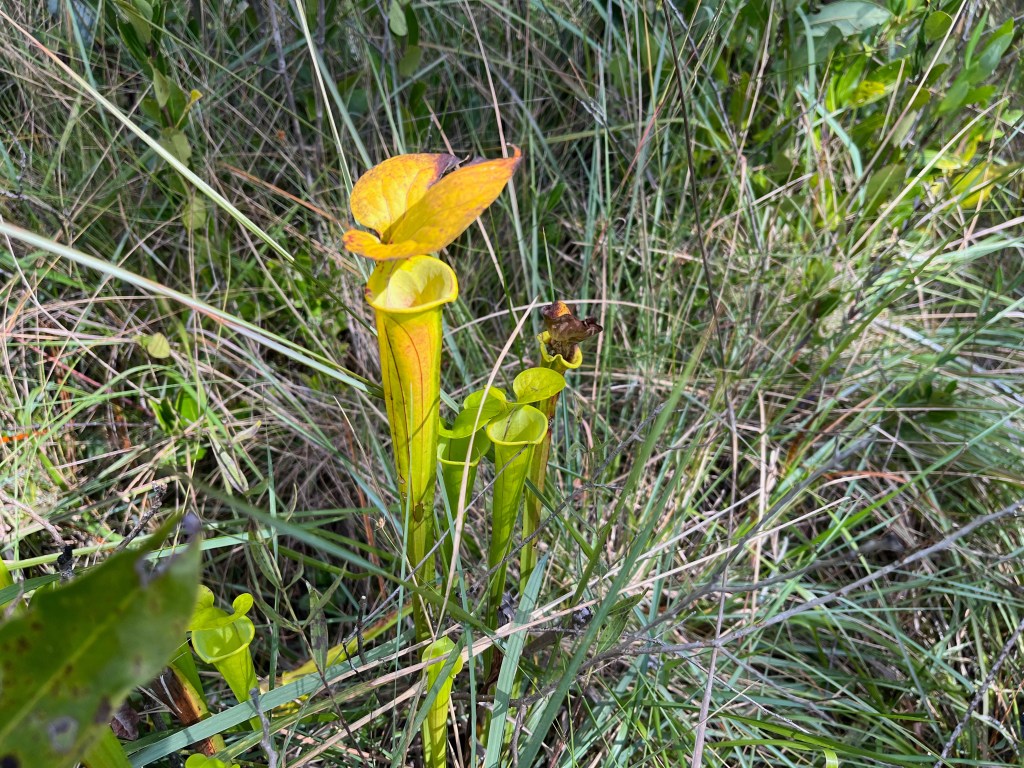
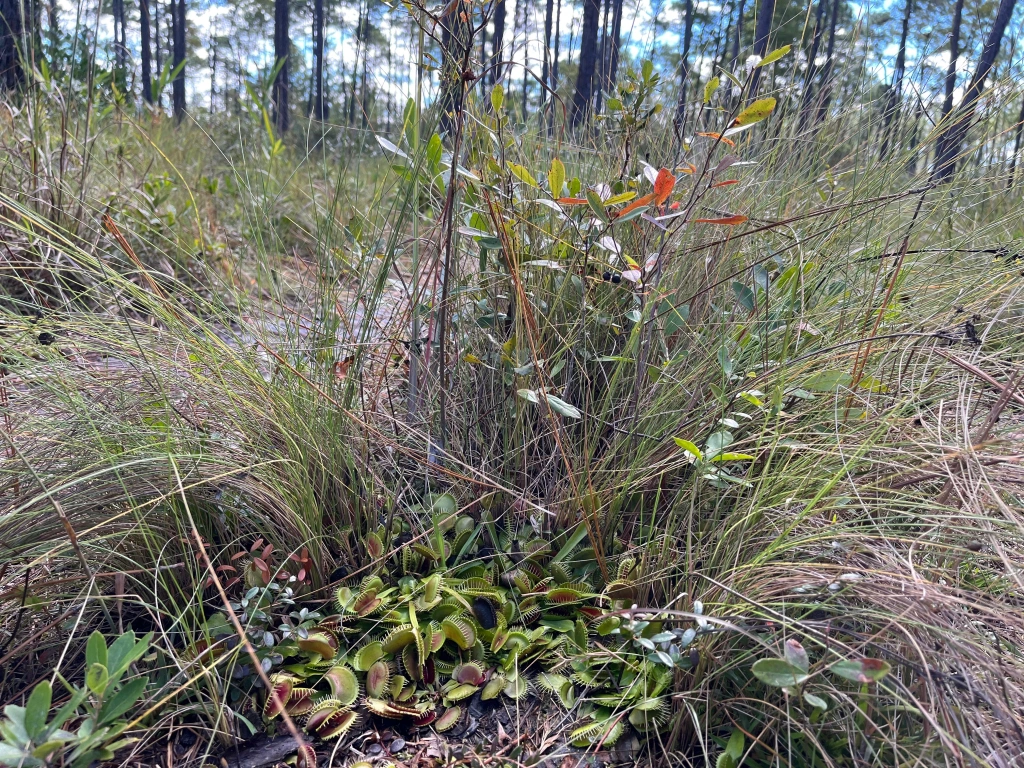
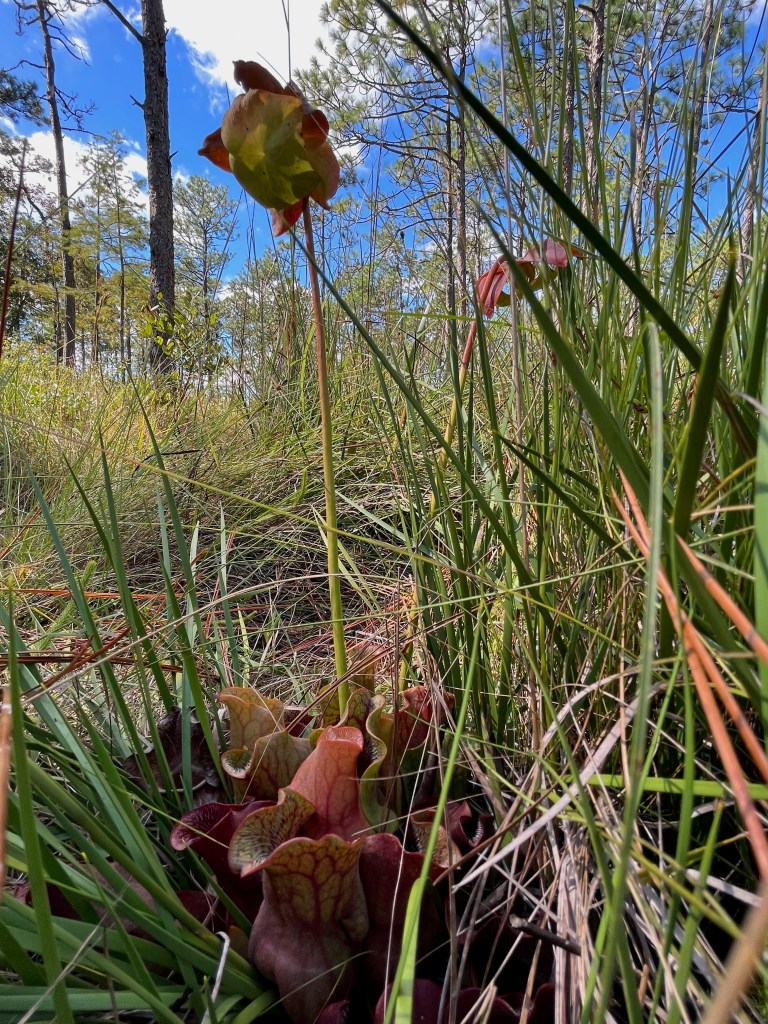
The Green Swamp preserve is the home of Venus Flytraps (Dionaea muscipula). However, disjunct populations in nearby Horry County, South Carolina also naturally occur. Other insectivorous plants, such as Pitcher Plants (Sarracenia), Sundews (Drosera), Bladderworts (Utricularia), and Butterworts (Pinguicula) all grow within the confines of the Green Swamp. Generally speaking, carnivorous plants grow in nutrient poor soil and have adapted, over time, to attract, allure, trap, and digest insects, gleaning nutrients from their hosts. They all have complex strategies of separately attracting duel sets of insects, for purposes of pollination and also digestion. Without exception, carnivorous plants have brightly enchanting colors, often neon. Pitcher Plants (Sarracenia) species (Red = rubra, Yellow = flava, Hooded = minor, and Purple = purpurea) are found in the Green Swamp. However, ranges of Sarracenia, especially Purples, are much wider (Maine and Michigan to Florida) than that of other species in the genus. Researchers have also found the insect paralyzing narcotic coniine on the lip of Sarracenia flava. This fascinating adaptation lulls insects into lethargy until they woozily fall into the pitcher.
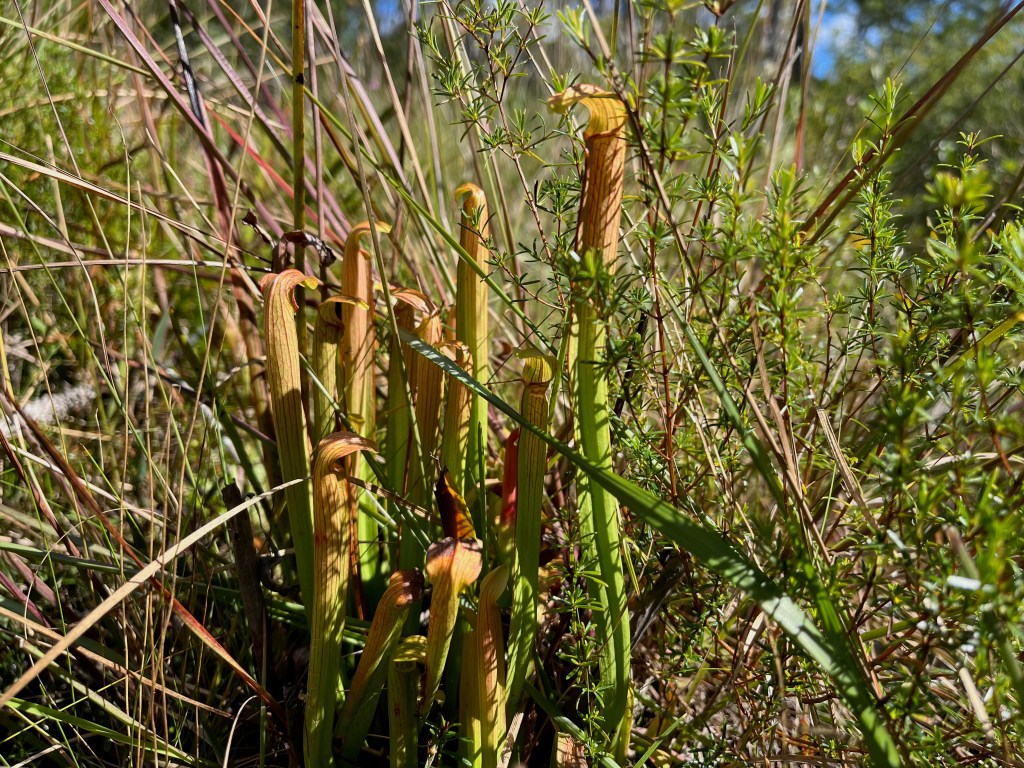
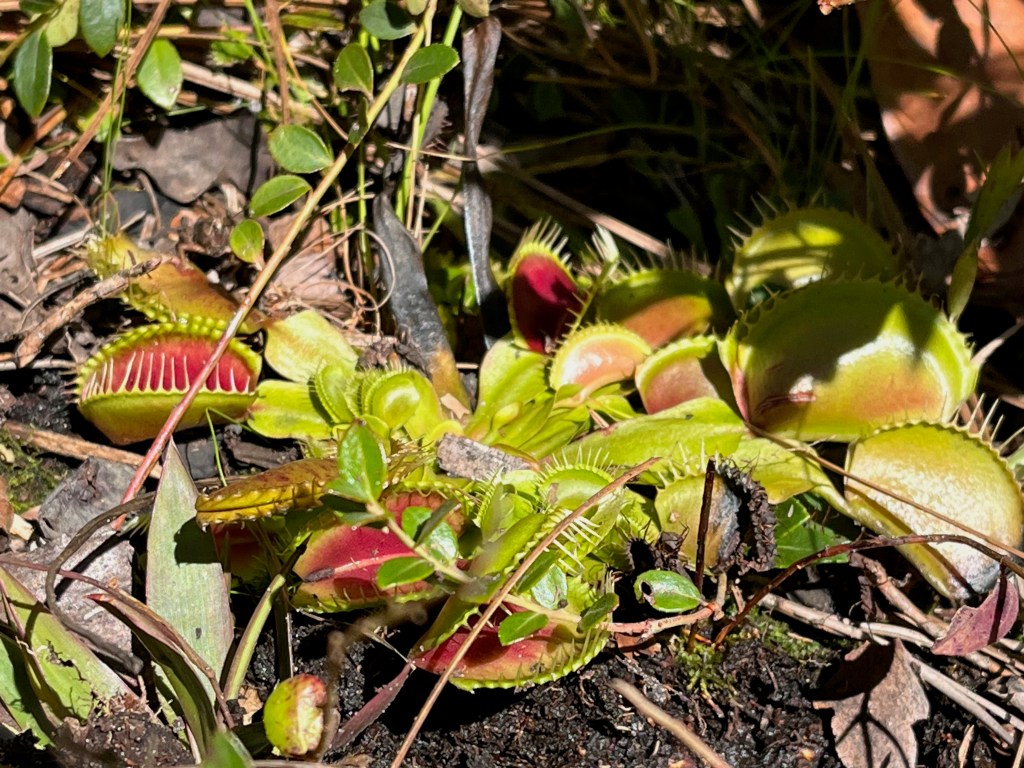
Outside of cultivation, the Venus Flytrap only grows within the 50 miles of this area. Venus flytraps (or VFTs) are perennially growing plants known for their appearance and “active” carnivorous traps. Only one other plant on Earth, the aquatic and miniature Waterwheel, (Aldrovanda vesiculosa) is known to have active traps that snap shut. The manner in which the VFT works is complex: there are 3-5 trigger hairs on the inside of each trap, 2 of these hairs have to be touched within a few seconds, the plant then senses an insect and sends off turgid pressure of water moving through the plants and closing the trap. The reason for 2 trigger hairs and not 1 need to be contacted may be to mimic the walking habits of an insect and not to waste energy on debris falling into the trap. From there, the trap has to grow open in a manner similar to the new growth of the leaves of a plant. Each trap has a lifespan of several open and closings before they are replaced by new traps growing from the base. To reproduce, the Venus flytrap grows a tall white flower spike once a year which attracts a different set of pollinators than those of the traps. It would be futile to eat your pollinator. Aptly named, the latin Dionaea muscipula means Aphrodite mousetrap. Tippitywichit is another common name, used in England. The common name is understood to be a thinly veiled entendre for a toothed vagina. Arthur Dobbs, governor of North Carolina in 1763, compared the mechanics of the plant to “an iron spring fox trap.”

Walking in the Green Swamp is akin to going back in time. These protected and rural areas of the Carolinas feel unchanged from the Swamp Fox Revolutionary War, the exploits of plant collecting of frenchman Andre Michaux, the annual seed gatherings of the Bartrams from Philadelphia, the French-Indian Wars and the days of the Waccamaw Indians.
The story of the Venus Flytrap is a story of names and history. Below are some standouts:
Arthur Dobbs (1689-1765) was a Scottish born, British military officer who bought an absurd 400,000 acres of land in North Carolina in 1745. He was later elected Governor of North Carolina and attempted to establish a permanent capital site in northeastern NC called George City. In 1759, Dobbs, who lived in Brunswick Town across the bay from Wilmington south of Lehland, recorded the first written description of the Venus Flytrap. The now non-existent ruins of Brunswick Town is less than 30 miles from the Green Swamp. In a letter to Peter Collinson, an English merchant and avid gardener, dated to January 24, 1760,
“The great wonder of the vegetable kingdom is a very curious unknown species of Sensitive (my note: Sensitive Plant or Mimosa curls it’s leaves when touched). It is a dwarf plant. The leaves are like a narrow segment of a sphere, consisting of two parts, like the cap of a spring purse, the concave part outwards, each of which falls back with indented edges (like an iron spring fox-trap); upon anything touching the leaves, or falling between them, they instantly close like a spring trap, and confine any insect or anything that falls between them. It bears a white flower. To this surprising plant I have given the name of Fly-trap Sensitive.”
Peter Collinson (1694-1768), merchant businessman and plant collector famously corresponded with Philadelphian and “Father of American Botany” John Bartram (1699-1777). Bartram and Collinson never met but exchanged hundreds of letters and traded plants and seeds for more than three decades. Bartram was an ex-communicated Quaker from the town of Darby, outside of Philadelphia. He was later appointed “the King’s Botanist” to England and was the first person to bring the Venus Flytrap into cultivation.

William Barton (1739-1823), son of John Bartram, artist and author of Travels Through North & South Carolina, Georgia, East & West Florida, the Cherokee Country, the Extensive Territories of the Muscolgulges, or the Creek Confederacy, and the Country of the Chactaws; Containing An Account of the Soil and Natural Productions of Those Regions, Together with Observations on the Manners of the Indians. Bartram writes enthusiastically of the “sportive vegetables” lining in the banks of streams and how “admirable are the properties of the extraordinary Dionaea muscipula!.”
Carl Linnaeus (1707-1778), a latin obsessed Swede who changed his own name to latin. ‘Father of Taxonomy,’ Linnaeus created the latin naming system based on plant flowers or plant sex. Linnaeus declared the carnivorous properties of the Venus Flytrap to be “against the order of nature as willed by God.”
William Young (1742-1785), dubbed the Pennsylvania Botanist to the Queen, imported living Venus Flytrap to another English merchant businessman moonlighting as a naturalist,
John Ellis (1710-1776), future Royal Agent for British West Florida, Ellis gave the Venus Flytrap the scientific name Dionaea muscipula. Ellis documented the VFT plant discovery to Linnaeus in 1770, Ellis included the first illustration of a Venus Flytrap in his essay Directions for bringing over seeds and plants, from the East Indies (1770).
Moses Ashley Curtis (1808-1872) was a Stockbridge, Massachusetts born Williams College botanist and Episcopalian priest who moved to Wilmington, North Carolina. Moses taught botany, advocated for the Venus Flytrap, published “Enumeration of Plants Growing Spontaneously Around Wilmington, North Carolina” in 1834. In 1986, a book titled A Yankee botanist in the Carolinas: the Reverend Moses Ashley Curtis, D.D. (1808-1872) was published.
Charles Darwin (1809-1882), Father of Evolution wrote the book Insectivorous Plants in 1892 where he obsessively studied the patterns and lives of carnivorous plants. He called the Venus Flytrap “one of the most wonderful plants in the world” with its “snap-buckling” traps.
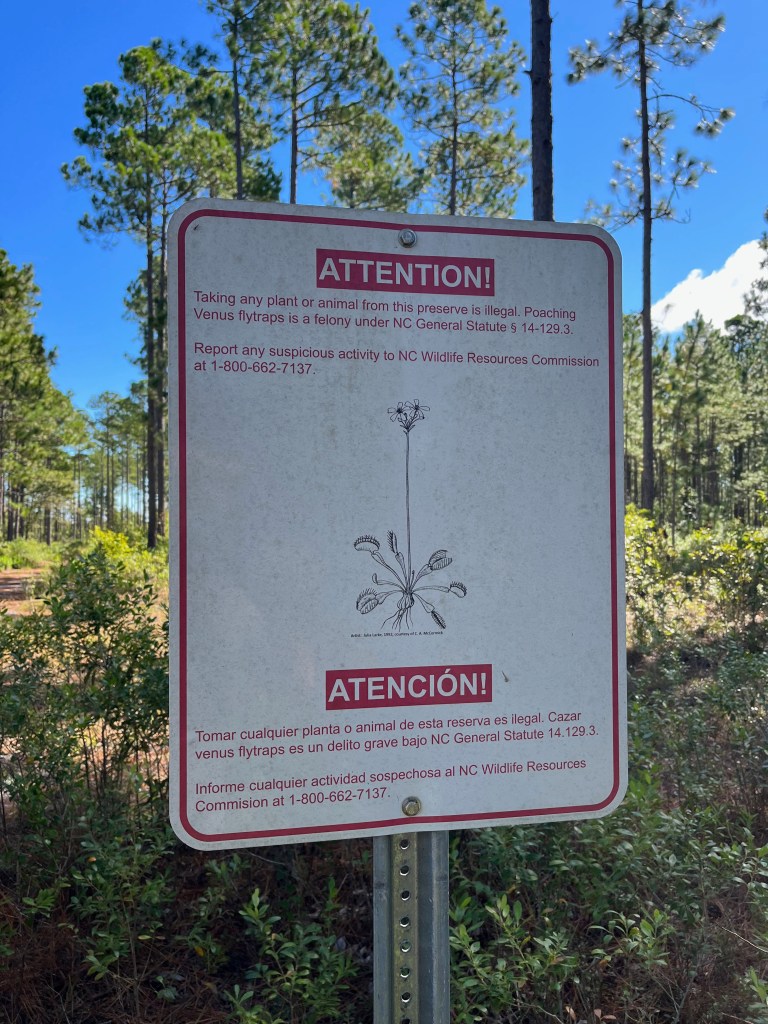
The story of the Venus Flytrap evolves into the present day. Unfortunately, the plant and entire Longleaf Pine carnivorous plant ecosystem is threatened by habitat loss, changes in hydrology due to development and road building, and rising sea levels which dangerously add salt water to the habitat. A few years ago, there was a strange tale of a medical company looking for a cancer cure through poaching carnivorous plants. Though difficult to police, it is now a felony to take a Venus Flytrap out of nature. Thankfully, the plant is easily propagated by seed and tissue culture where labs, often in Florida, can genetically Xerox thousands in a day. Increased awareness has brought a conservation based mindset into the mainstream. North Carolina recently unveiled a Venus Flytrap license plate with partial proceeds going towards conservation and education. See the thorough yet complicated timeline here. In other news, there is a plan to expand a nearby road and its impact could have detrimental effects on the hydrology of the Green Swamp.
The Green Swamp experience shows there are botanical wonders hiding in plain sight and within driving range. The complicated yet fragilely connected network of plants, soils, trees, bacteria, fungi, insects, and mammals provide examples of interconnectedness and lessons for reliance in one another. The future chapters of the Green Swamp and the Venus Flytrap will depend on continued awareness and wonder in the natural world. This continued human curiosity will continue the story for future generations of plants, animals, and people.

 Green Is The Color
Leave a comment